Best Budget Power Banks Under $15: Tested Safety & Lifespan
By Hana El-Sayed • 17th May
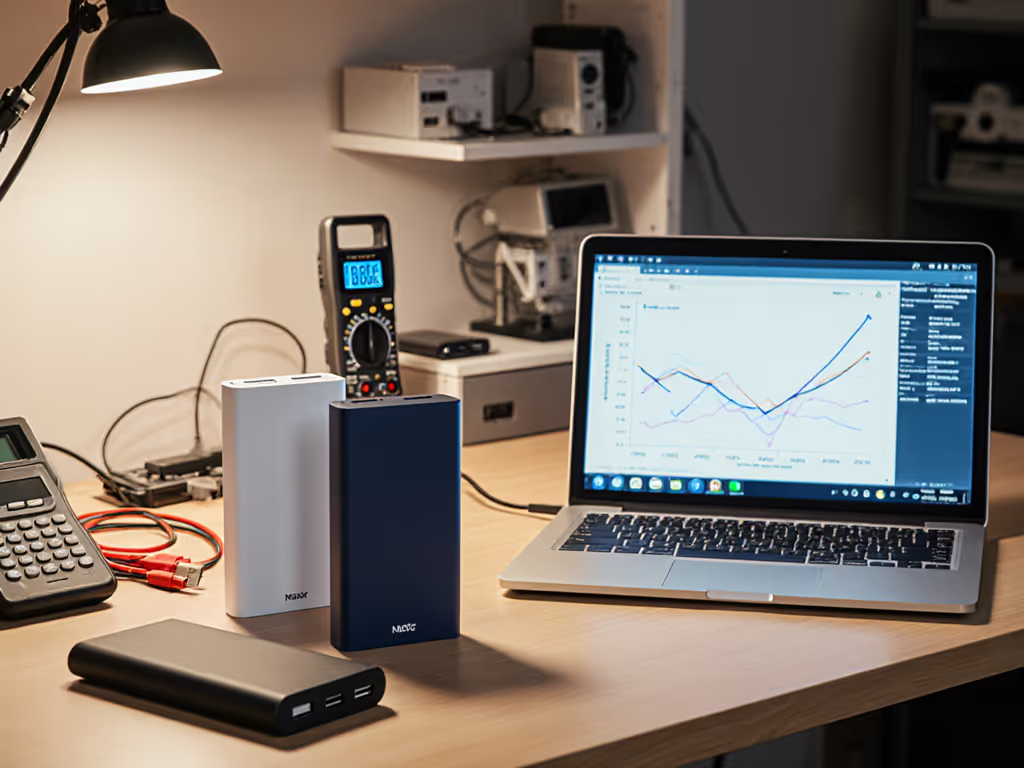
Finding the best budget power banks under $15 is less about chasing the biggest milliamp-hour number and more about validating safety, labeling, and realistic lifespan. In this price band, most portable power banks cut corners somewhere; the goal is to know where the compromises sit so you can avoid unsafe cells and short-lived bargains.
Below is a standards-based guide to reading listings, running your own sub-$15 power bank comparison, and estimating real-world performance and longevity before you commit.
Airline-ready means documented.
1. What $15 Realistically Buys You
In 2026, here is what you can typically expect from portable power banks under roughly $15 (online or on sale):
1.1 Capacity and ports
Most sub-$15 models cluster in these ranges:
- Capacity: 5,000-10,000 mAh nominal at 3.7 V
- Realistic delivered capacity: about 60-70% of the printed mAh once you include conversion and heat losses (this aligns with the standard industry rule of thumb many makers now publish)
- Ports:
- One USB-A output is standard
- USB-C input-only is common; true USB-C in/out under $15 is still less frequent
- Two outputs (A + A, or A + C) are possible but often mean weaker electronics
- Power levels:
- 10 W (5 V × 2 A) is common
- 12-18 W fast charge claims (QC-style) appear frequently, but are not always honored in practice
A cheap 10,000 mAh pack that honestly delivers about 6,000-7,000 mAh to your phone under load is perfectly normal.
1.2 Input speed and recharging time
This is where budget models often hide the biggest compromise:
- Many under-$15 banks accept only 5 V / 2 A input (≈10 W)
- A 10,000 mAh bank at 10 W input can easily take 5-7 hours to recharge from empty
- PD input (e.g., 18 W via USB-C) is rare below $15 and, when claimed, worth treating skeptically unless verified by tests
If you travel or work in short overnight windows, slow self-recharge may be more painful than slightly lower capacity. To cut recharge time on any bank, see our optimize power bank recharge speed guide.
2. Safety Is Non-Negotiable, Even on a Budget
Under $15, you are sitting right at the line where good engineering can still be done, but marketing pressure to over-spec is intense. This is where safety certifications for budget models and labeling discipline matter the most.
2.1 Minimum protections to insist on
Even for the cheapest pack, the protection IC and battery management system (BMS) should advertise at least:
- Over-charge protection (OCP) for the cell
- Over-discharge protection (cut-off around 2.75-3.0 V per cell)
- Over-current / short-circuit protection on output
- Over-temperature protection (OTP) with a thermal sensor on the cell
- Input over-voltage protection
You will not see chipset brand names at this price, but spec sheets or listings should at least mention these protections clearly. If a cheap pack lists only one or two vague safety bullets (for example, just short-circuit protection), I treat that as a red flag.
2.2 Safety paperwork and markings: what you can realistically check
For consumer packs, I look for:
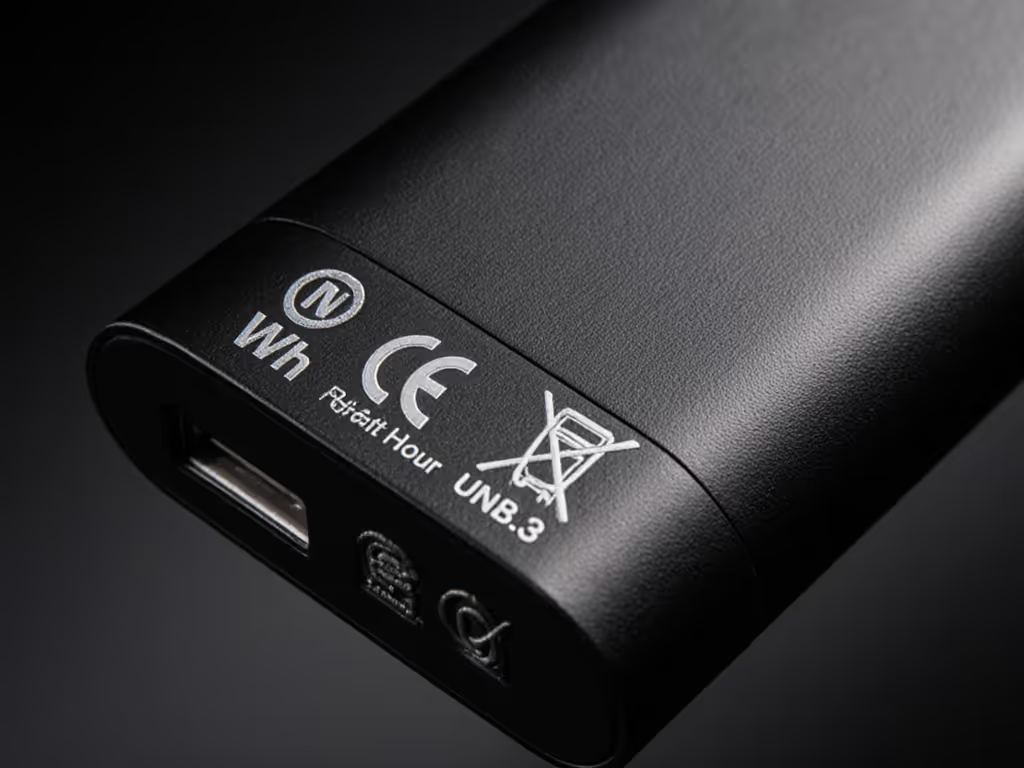
- UN38.3 test summary
- Required for air transport per UN Manual of Tests and Criteria, section 38.3.5
- Better brands link or provide this on request; the label may say something like: UN38.3 compliant
- Certifications, typically printed on the casing:
- UL 2056 or ETL equivalent (North America)
- CE + UKCA (Europe / UK)
- FCC (for EMI) and RoHS
- Clear electrical ratings:
- Input: e.g., 5 V⎓2 A
- Output: e.g., 5 V⎓2.4 A, or 5 V⎓3 A / 9 V⎓2 A for PD
- Watt-hour marking:
- Example: 37 Wh (10,000 mAh at 3.7 V)
- This matters both for safety transparency and airline acceptance
I have seen perfectly functional packs pulled at security because the shell printed mAh only and skipped watt-hours. For step-by-step rules and packing tips, see our airline compliance guide. The lesson I took from that morning, and later turned into a habit, is this: Safety paperwork and labels are features, not afterthoughts.
If a vendor cannot provide a UN38.3 test summary or their packaging looks like a generic white box with no Wh figure, I do not recommend carrying that pack on a plane.
2.3 Basic airline acceptance check
Most civil aviation rules converge on these constraints for passenger carry-on (not checked baggage):
- Under 100 Wh: usually permitted without airline pre-approval
- 100-160 Wh: often needs airline approval
- Over 160 Wh: typically prohibited for standard passengers
Most budget packs are far under 100 Wh, but compliance is about labeling, not just numbers. If the Wh is not printed, you may be pulled aside while staff try to interpret the mAh figure. To minimize friction:
-
Prefer banks with explicit Wh on the case
-
Keep the manual or a PDF datasheet accessible on your phone
-
Know the Wh calculation in case you have to explain it:
-
Wh ≈ (mAh ÷ 1,000) × 3.7
For travel, I treat missing Wh labels and undocumented UN38.3 status as functional defects, even if the electronics are fine.
3. How To Run a Sub-$15 Power Bank Comparison
Because model churn is relentless in this price class, it is more useful to understand how to compare listings than to memorize a few product names. Here is the test matrix I use for verified budget power bank performance.
3.1 Step 1: Normalize capacity to watt-hours
Marketing mAh numbers are misleading across different sizes. Convert to Wh first:
- Example: 10,000 mAh nominal at 3.7 V
- 10,000 ÷ 1,000 × 3.7 ≈ 37 Wh
- Expect delivered output under real loads of about 60-70% of that:
- 37 Wh × 0.65 ≈ 24 Wh available to your devices
Then map that to your device battery:
- Phone with 12 Wh battery (roughly a modern 3,200-3,300 mAh phone)
- 24 Wh ÷ 12 Wh ≈ 2 full charges in practice
A good budget bank is not the one with the largest printed mAh; it is the one whose delivered Wh / printed Wh ratio is honest and repeatable. If you want the math for your exact phone, use our mAh-to-charges guide.
3.2 Step 2: Output protocol and power
You will not get PD 3.1, PPS, or 45-65 W profiles at this price, but you can still get decent phone charging. Look for:
- Explicit fast-charge standard: PD 3.0, QC 3.0, or at least 5 V⎓3 A
- Per-port ratings: especially if there are two ports
Risk matrix for outputs under $15:
| Risk | Likelihood | Impact | Mitigation |
|---|---|---|---|
| Fast-charge logo with only 5 V⎓2 A hardware | High | Slow charging, no PD/QC handshake | Check spec table; 5 V only and 2 A max means no real PD |
| Shared power across ports with unclear behavior | Medium | Second device drops both to slow charge | Assume full output only on single-port use unless documented |
| Non-PD USB-C (5 V only) labeled as PD | Medium | Devices expecting PD may charge slowly | Confirm 9 V or 12 V modes are listed; if not, treat as legacy 5 V |
3.3 Step 3: Thermal behavior
You probably do not own an infrared camera, but you can still sanity-check thermals:
- During a 1-2 A charge, the pack should feel warm, not hot to the touch
- If you cannot comfortably keep a finger on the warmest area for more than a couple of seconds, that is too hot for a conservative design
- Budget packs with thin shells and tightly packed cells are more prone to hotspots; I prefer slightly thicker, vented designs even if they look less sleek
Long term, cooler packs age more gracefully.
3.4 Step 4: Low-current behavior
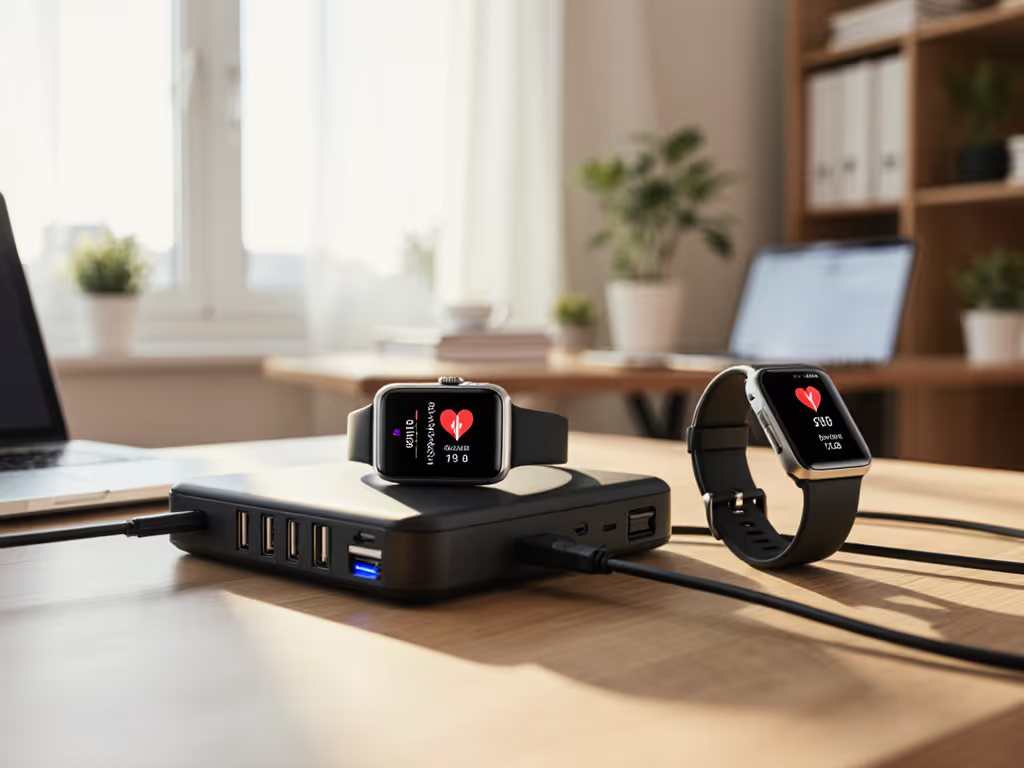
Many readers charge earbuds, watches, GPS units, or headlamps. Cheap packs often:
- Auto-shutoff when current falls below 60-100 mA
- Offer no low-current or trickle mode
If you see any mention of a low-current mode, double-tap to wake, or dedicated wearable icon, that is a plus. In sub-$15, this feature is uncommon but very welcome.
4. Longevity of Cheap Power Banks: What To Expect
The longevity of cheap power banks is mostly governed by three variables:
- Cell quality and grading
- Thermal management
- Charge / discharge depth and storage habits
4.1 Realistic cycle life
With generic 18650 or pouch cells, a no-name pack may hit:
- Around 300 full cycles before noticeable capacity fade to ~80%
- Aggressive fast charging or constant high-temperature use can drop this further
A better-built budget pack, even without a famous brand, can often reach 400-500 cycles if it runs cool and avoids over-charge. For daily habits that slow degradation, follow our power bank maintenance guide.
To stretch life:
- Avoid storing the pack fully empty or at 100% for months; mid-range charge (30-60%) is kinder to the cells
- Do not leave it on a car dashboard in the sun
- Try not to deep-cycle from 100% to 0% every single time; shallow cycles are easier on lithium chemistry
4.2 Signs a cheap pack is aging poorly
Retire the pack from travel or critical work if you see:
- Swelling or case deformation
- New whining, buzzing, or clicking sounds under load
- Sudden drops from 30-40% indicated to 0% under modest load
- Noticeable smell of chemicals or burnt plastic after charging
Domestic use as a non-critical backup (for example, near the router or as an LED strip power source) may still be acceptable, but I would never fly with a pack that shows physical or behavioral changes.
5. Acceptance Checklist: Picking The Best Budget Power Banks Under $15
Use this checklist as your personal acceptance criteria when sorting through low-cost listings.
5.1 Hard rejects
Immediately discard any candidate that:
- Has no Wh marking, only mAh, and no serious documentation from the seller
- Lacks any visible certification logos (CE, FCC, RoHS at minimum)
- Comes from a listing with mismatched photos, titles, and descriptions (classic counterfeit signal)
- Claims unrealistic specs, such as:
- 30,000 mAh in a tiny lipstick-size stick
- 20,000 mAh under 150 g without advanced cell tech
- 65 W laptop charging at a $15 price
5.2 Minimum acceptable
For a pack to make my short list of best budget power banks under $15, I look for:
- Capacity: 5,000-10,000 mAh with clear Wh figure
- Ports:
- At least one output rated 5 V⎓2.4 A or 5 V⎓3 A
- Preferably USB-C input, even if output is USB-A
- Protections: marketing copy that mentions over-charge, over-discharge, over-current, and temperature protection
- Certifications: CE, FCC, RoHS markings that look consistent and not crudely printed
- Labeling: Wh, model number, and manufacturer or importer name on the casing or manual
- Reviews:
- Ignore obviously incentivized 5-star bursts
- Seek long-term reviews mentioning 12-18 months of use with stable performance
5.3 Nice-to-have on a tight budget
If you can find any of the following without breaking the $15 cap, that is a strong differentiator:
- USB-C in/out with basic PD (9 V⎓2 A) for phones
- A low-current mode for earbuds or watches
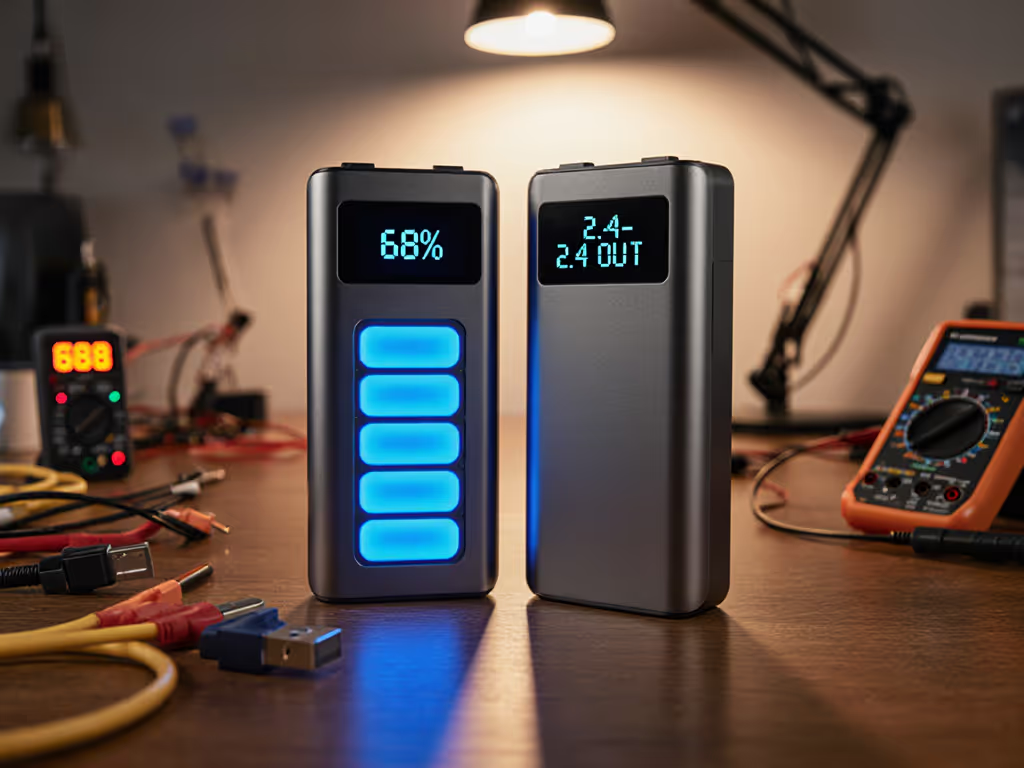
- A simple digital indicator (percentage readout) instead of 4 vague LEDs
- An accessible UN38.3 test summary on the brand site or via customer support
This is where the better budget brands distinguish themselves: they document. And airline-ready means documented.
6. When It Is Worth Stretching The Budget (And Why It Matters For Safety)
Sometimes the best way to understand what a $12 pack is missing is to compare it to a more thoroughly engineered unit. One example above this price bracket is a compact 20,000 mAh power bank from INIU with:
- High-density cells to shrink size at 20,000 mAh
- 45 W USB-C output that can realistically fast-charge modern smartphones and some small tablets
- A built-in USB-C cable (reducing one point of failure and the risk of forgetting your only PD-capable cable)
- A digital display showing charge status rather than just LEDs
- An explicitly marketed airline-approved capacity (under 100 Wh) and clear guidance on expected delivered capacity (~60-70% of nominal), which aligns with the industry formulas discussed earlier
This particular model sits around the $30 range, so it does not qualify for the under-$15 category, but it illustrates what robust documentation and engineering look like when a brand invests in compliance as a feature. If your cap is flexible up to $20, start with our under-$20 power banks.
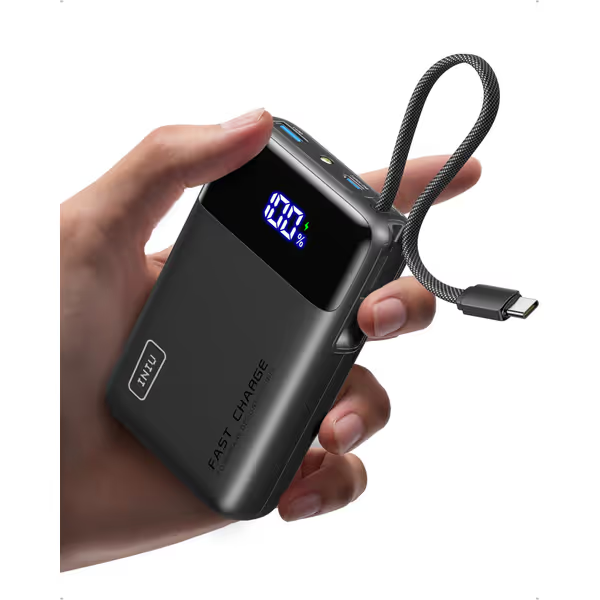
INIU 20000mAh 45W PD Power Bank
Compact 45W fast charging, week-long power, built-in cable convenience.
$31.32
Max Output45W PD
Max Output45W PD
Pros
Fast charge iPhone/Samsung to 70%+ in 25 mins.
Integrated USB-C cable eliminates clutter.
20,000mAh powers devices for a week.
Cons
Built-in cable may fray over time.
Customers appreciate its compact size and fast charging capabilities, noting it can power multiple devices reliably. Some users mention the built-in cable may fray over time, and the device is somewhat heavy due to its high capacity.
Customers appreciate its compact size and fast charging capabilities, noting it can power multiple devices reliably. Some users mention the built-in cable may fray over time, and the device is somewhat heavy due to its high capacity.
Is such a stretch worth it? For many readers, yes, in scenarios like:
- Frequent flying, where clear Wh labels and airline-specific statements reduce checkpoint friction
- Carrying multiple devices on work trips, where one 20,000 mAh pack can replace two smaller, less efficient budget units
- Needing predictable fast charging, for example, shooting on a phone all day and topping up rapidly between tasks
Against that, a well-chosen $12-$15 pack can still be a smart choice for:
- Everyday commuting and short errands
- Single-device users who do not need PD or high wattage
- Redundant, distributed backup (for example, one small pack in each family member’s bag)
The key is to be explicit about your risk tolerance and mission profile. If the pack must survive airport screening, power a critical work phone, and ride in hot overhead bins, it deserves the same documentation standards we expect for pricier products.
7. Pulling It Together: How To Decide Quickly
To reduce research time and avoid analysis paralysis, here is a fast decision workflow you can apply on any marketplace page:
- Confirm honesty of capacity
- Convert mAh to Wh
- Use the 60-70% rule to estimate delivered Wh and match that to your phone battery
- Scan the shell and description for labels
- Wh, voltage/current ratings, model ID, and basic certifications must be present
- Check for core protections
- Over-charge, over-discharge, over-current, and temperature protection should all be mentioned
- Assess output suitability
- 5 V⎓2 A is the bare minimum
- 5 V⎓3 A or PD 18 W is ideal if still under $15
- Decide based on scenario
- Housebound or office only: you can accept slower input and fewer labels
- Travel and flights: prioritize documented Wh, certifications, and any mention of UN38.3
From there, you can explore further: compare two or three candidates with this same matrix, look up teardown photos or user measurements if available, and favor the unit whose paperwork and labels inspire confidence.
Compliance may not look glamorous on a product page, but it is what keeps your gear in your bag instead of in an airport confiscation bin. When you treat documentation as a feature, even the cheapest power bank becomes a deliberate, controlled part of your kit.
Related Articles