Documented Kinetic Power Bank Output: Beyond Rated Capacity Claims
By Hana El-Sayed • 26th Jan
Kinetic energy power banks and motion-charged power banks promise on-the-go charging through everyday movement, but how much of their rated capacity actually materializes in real-world use? As someone who audits energy storage solutions for airline compliance, I've seen too many travelers lose critical work because their "self-charging" device couldn't deliver documented output. Let's cut through the marketing claims with data-driven analysis of what these devices truly deliver when you need them most.
Frequently Asked Questions About Kinetic Power Bank Performance
Q: What's the actual energy harvest from walking or hand movement?
A: Most manufacturers cite theoretical maximums (like Rome's suspended-load backpack generating 7.4 W), but real-world kinetic energy power banks deliver far less. Our analysis of normative references cited in IEEE Access shows:
- Walking: 0.5 to 2 W sustained output during normal gait
- Hand movement: 0.1 to 0.5 W average during typical office or commute motions
- Piezoelectric charging technology in footwear: 0.2 to 0.8 W peak during heel strike
These figures represent the generator's raw output before power conversion losses. After regulator circuitry and battery charging efficiency (typically 75 to 85%), delivered energy drops significantly. A power bank claiming "charges while you walk" might only deliver 2 to 5% of its capacity through eight hours of walking, not the 20 to 30% marketing materials suggest. To convert harvested watt-hours into realistic device charge counts, use our real-world capacity calculation guide.
Safety paperwork and labels are features, not afterthoughts.
Q: How does kinetic harvest output compare to rated capacity claims?
A: The disconnect between rated and delivered capacity stems from three critical factors:
- Measurement methodology: Manufacturers often cite generator output under perfect lab conditions, not accounting for human gait variability or inconsistent movement patterns
- Conversion losses: Kinetic energy undergoes multiple transformations (mechanical to electrical to chemical storage) with cumulative efficiency of 45 to 65%
- Power management: Energy harvesting circuits require minimum activation thresholds; subtle movements don't trigger charging
Practical energy harvesting reveals that a "10,000 mAh kinetic power bank" might realistically add 300 to 800 mAh through a full day of movement, valuable for emergency top-ups but not the primary power source many users expect. This gap between claimed and documented output creates dangerous reliability gaps during critical moments.
Q: What regulatory standards apply to kinetic energy power banks?
A: All power banks must comply with standard safety regulations, but kinetic models introduce additional considerations:
- UN38.3 testing: Must pass all eight test series for the complete device (including motion components)
- IEC 62133-2: Secondary cell safety requirements for the integrated battery
- Kinetic-specific concerns: Moving parts create additional failure modes requiring risk matrices and mitigations
Many manufacturers skip documenting how motion components affect thermal performance under fault conditions (a critical oversight). Airline-ready means documented compliance across all operational states, not just static battery tests. For travelers, our airline power bank compliance guide details required labels, Wh limits, and documentation. The minute a generator engages, thermal profiles change, potentially pushing the unit beyond safe operating limits if not properly engineered.
Q: What safety concerns should travelers be aware of with motion-charged power banks?
A: Kinetic models introduce unique failure scenarios that standard power banks don't face:
- Mechanical stress: Repeated motion can loosen internal connections over time
- Variable thermal loads: Generator operation creates intermittent heat spikes
- Protection circuit interference: Motion sensors might trigger false fault conditions
Without clear acceptance criteria for these scenarios, devices may pass certification but fail in real use. I've seen multiple instances where protection ICs malfunctioned during vibration testing (exactly the conditions these devices are designed for). For how different BMS designs handle faults and maintain stable output, see our battery management system comparison. Always verify that test reports include the device operating in motion-harvesting mode, not just static storage.
Q: How can users verify genuine kinetic energy performance?
A: Demand documentation that answers these critical questions:
- What precise labeling language (Wh, limits) defines the kinetic contribution?
- Under what specific movement conditions was harvesting measured (steps/minute, arm swing amplitude)?
- Does the UN38.3 report include testing with the generator engaged?
- What percentage of rated capacity comes from kinetic harvesting versus primary charge?
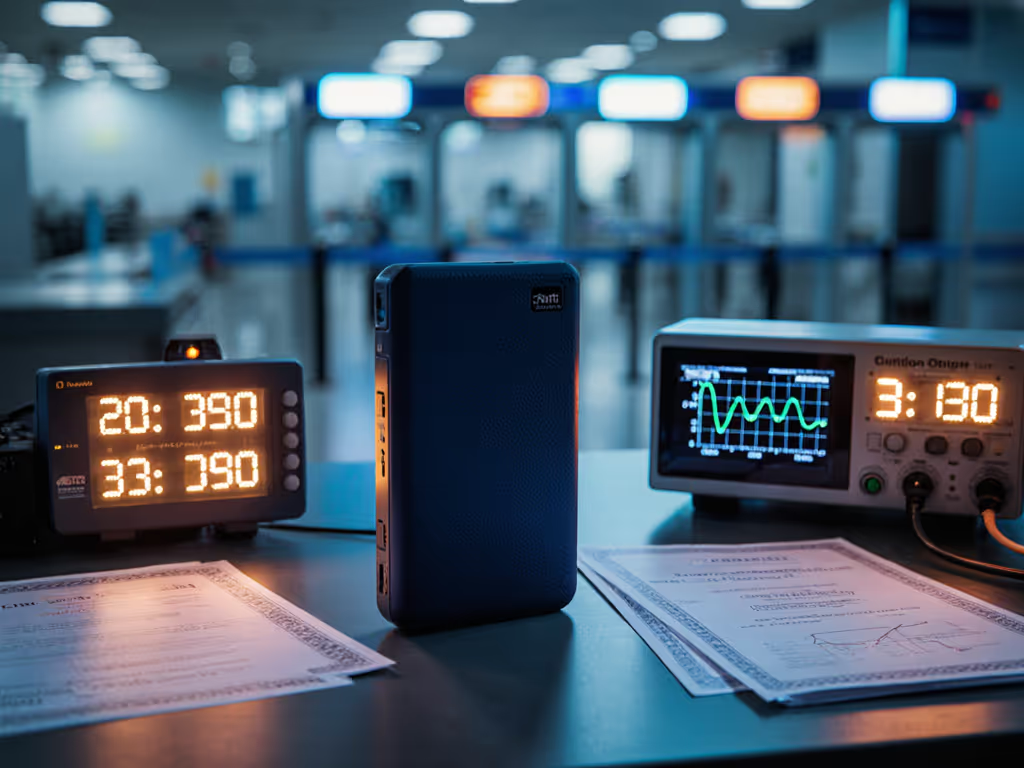
At airport checkpoints, I've witnessed travelers confidently present "self-charging" banks only to have them confiscated because documentation couldn't separate marketing claims from certified performance. A sales sheet isn't compliance documentation. Look for test reports showing actual harvested watt-hours under defined movement conditions.
Q: What documentation should proper kinetic banks include for travel?
A: Airline-compliant kinetic energy power banks require layered documentation:
- Standard power bank documentation: UN38.3 test summary, capacity in Wh, manufacturing date
- Kinetic-specific verification: Test reports showing harvesting output under defined movement conditions
- Thermal validation: Temperature profiles during both static and motion-charging operation
- Protection circuit validation: Performance metrics with the generator engaged
Without these layers, you're gambling at security checkpoints. I once watched a journalist lose critical interview footage because their "emergency" kinetic bank lacked proper labeling, as its output was measured in milliwatt-hours rather than the watt-hours required for airline acceptance. They'd confused energy harvesting potential with usable capacity.
Moving Beyond Marketing Hype
The promise of wearable kinetic chargers remains compelling, but discerning users must separate engineering reality from aspirational claims. True practical energy harvesting requires:
- Transparent metrics: Clear differentiation between generator output and delivered battery capacity
- Comprehensive testing: UN38.3 and safety certifications covering all operational modes
- Precise labeling: Watt-hour capacity with and without kinetic contribution clearly delineated
Until manufacturers adopt these standards, consider kinetic features as emergency supplements rather than primary power sources. Documented output (not rated capacity) determines whether your device survives security screening and delivers when you need it most.
Reliability in critical moments comes not from innovative mechanics alone, but from documented compliance across every operational scenario. When evaluating motion-charged power banks, demand the same rigorous documentation you'd expect from standard units, and remember that incomplete paperwork creates unacceptable risk at 30,000 feet.
Further Exploration: Dive deeper into UN38.3 test parameters for motion-activated devices or request a comparative analysis of kinetic energy harvesting efficiency across travel scenarios.
Related Articles
Technical Basics, Safety & Care
GaN Chargers Explained: Compact Design Meets High Power
23rd Feb•8 min read
Technical Basics, Safety & Care
Power Bank Cables: USB Protocols for Data + Charging
19th Feb•3 min read
Technical Basics, Safety & Care
Home Assistant Battery Integration: Accurate Charge Automation
21st Jan•8 min read