Product & Brand Comparisons
Best Budget Power Banks Under $15: Tested Safety & Lifespan
17th May•13 min read
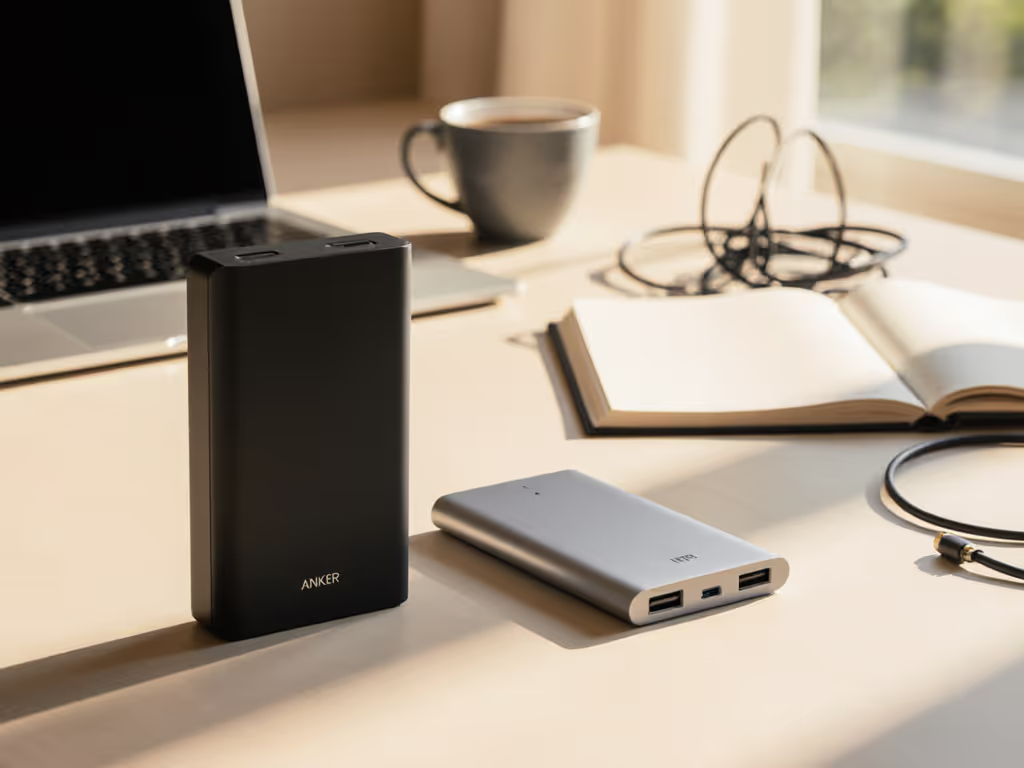
The Anker Nano vs Xiaomi UltraThin decision is not really a contest between two interchangeable "best compact power bank" options. The Anker Nano Power Bank 10K 45W is a 10,000mAh wired-first bank with a retractable USB-C cable and multiple outputs; the Xiaomi UltraThin Magnetic Power Bank 5000 15W is a 5,000mAh magnetic model built around exceptionally low carry bulk. Pick the one that matches the moment you need to solve: more stored energy and cable-based flexibility, or the thinnest possible phone-back companion.
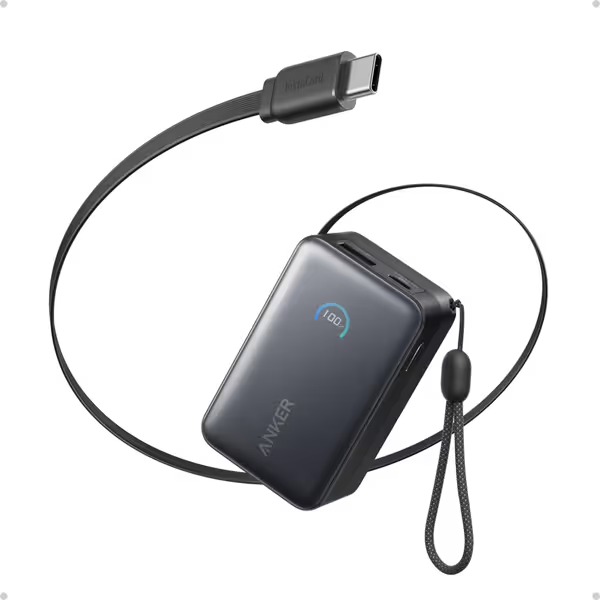
That distinction matters more than the headline word "fast." A 45W maximum, Xiaomi's 15W magnetic charging designation, 10,000mAh, and 5,000mAh describe different parts of the charging experience. They do not tell us how many full phone recharges either bank will deliver in your daily use, nor do they guarantee the rate your particular phone will request.
Here is the short answer: choose Anker when you want a compact travel bank that can charge through USB-C, carries a built-in cable, and offers more nominal capacity. Choose Xiaomi when a 6mm, 98g magnetic bank is the priority and you accept the smaller 5,000mAh class. If your workday includes a phone, earbuds, handheld, or a surprise cable need, Anker is the more versatile tool. If you want your phone to remain as pocketable as possible while attached to power, Xiaomi has the clearer physical-design advantage.
| Question | Anker Nano Power Bank (A1638) | Xiaomi UltraThin Magnetic Power Bank 5000 15W | Better fit |
|---|---|---|---|
| Named capacity | 10,000mAh | 5,000mAh | Anker for a larger energy reserve |
| Primary documented proposition | Wired charging via built-in retractable USB-C cable and ports | Magnetic charging | Depends on whether you prefer a cable or attachment-free use |
| Maximum documented power | 45W from one USB-C cable or USB-C port | 15W named magnetic charging power | Anker for higher single-output headroom |
| Ports/cable | One USB-C port, one USB-A port, and one built-in retractable USB-C cable | Check current Xiaomi specifications | Anker for documented connection flexibility |
| Documented size/weight | 3.21 × 1.99 × 1.42 inches; 0.51 lb | 6mm thick; 98g | Xiaomi for thinness and low weight |
| Cable to carry | Built-in 2.3ft retractable USB-C cable | Check the current regional package | Anker for fewer loose pieces |
| Multi-device rules | Documented combined-output limits | Check current Xiaomi specifications | Anker, with an important power-sharing caveat |
| Best use case | Long day, wired top-ups, multiple device types | Minimalist magnetic phone backup | Scenario-dependent |
The matrix also explains why this is a wired vs magnetic power bank choice before it is a brand choice. For a broader look at size-versus-capacity compromises across leading ultra-portables, see our compact power bank comparison. The Anker is a small power station for a cable-based kit. Xiaomi is a slim magnetic layer for a phone-centric kit.
Anker identifies this exact model as the Nano Power Bank (10K, 45W, Built-In Retractable USB-C Cable), model A1638. Its manufacturer-stated 10,000mAh capacity is double Xiaomi's named capacity, but do not turn that ratio into a promised number of recharges. Nominal mAh is not a delivered-energy test.
What is clear is the connection layout:
Anker Nano A1638

Built-in retractable USB-C cable ──→ USB-C device
USB-C port ──→ USB-C device or bank recharge
USB-A port ──→ USB-A cable/device
That architecture is practical when a cable is the bottleneck. The built-in cable is 2.3ft long, so it can reach from a bag or pocket to a phone without bringing a separate USB-C lead. Anker also states the cable was tested for 20,000 bends and 20,000 pulls.
Anker specifies up to 45W maximum from either the built-in USB-C cable or the USB-C port when one of those outputs is in use. The USB-A output is specified at up to 22.5W. This makes the Anker the better candidate when your device and its charging arrangement are designed to use a higher-power wired input.
But maximum output is a ceiling, not a promise that every phone will charge at 45W. Your device chooses a compatible charging profile, and real charging rate can change during a session. To understand whether your phone prefers PD, QC, or PPS—and what that means for real charging speeds—see our PD vs QC power bank guide. Check Anker's current compatibility documentation for charging-profile details.
Pair the cable right: the bank, cable, and device have to agree on a charging path before the headline wattage matters.
That sounds fussy until you have seen a supposedly fast bank crawl along because the cable in the bag was the limiting component. The cable is a component, not an accessory. The retractable lead also means you do not need to carry a separate USB-C cable for that charging path. If you use the USB-C port instead, verify the capability of your own cable and the charging requirements of your device rather than assuming any USB-C cable will produce the same result.
The Anker is not a "45W plus everything else" bank. Its published sharing rules are specific:
So, charge a single priority device when you need the highest documented USB-C output. Add a second or third device only when a slower shared allocation is acceptable. This is the kind of port-label detail that prevents an unpleasant airport surprise: connection count changes the available power path.
Anker specifies up to 30W input through either its USB-C cable or USB-C port. That means a compatible USB-C source can be used to recharge the bank at up to that stated maximum. It measures 3.21 × 1.99 × 1.42 inches and weighs 0.51 lb.
Anker lists compatibility with iPhone SE and iPhone 12 through 17 series, Samsung S22 through S24 and Note20/Note20 Ultra, and Google Pixel 6 through 9. That is a manufacturer compatibility list, not a measured speed chart. Owners of iPhone 14 and earlier models should note the documented requirement: a USB-C-to-Lightning cable or adapter is needed and is not included.
Xiaomi identifies the Xiaomi UltraThin Magnetic Power Bank 5000 15W as a 5,000mAh, 15W magnetic model with a 6mm body and a 98g weight. Those two physical specifications are its strongest documented differentiator. This is the bank for someone who values a thin magnetic add-on more than a larger energy reserve or a documented cable-and-port toolkit.
A magnetic bank changes the everyday workflow: For realistic expectations on speed and heat, see our wireless power bank efficiency guide.
Xiaomi UltraThin

Magnetic charging path ──→ phone
There is no loose cable to route for the magnetic charging path. That can be ideal for messaging, maps, boarding passes, or casual use when you want the phone and bank to move as one piece.
Xiaomi's documented highlights are the 5,000mAh capacity, 15W magnetic designation, 6mm body, and 98g weight. Confirm exact phone-and-case compatibility, connection options, included accessories, and warranty in the current regional listing before buying.
Choose Xiaomi if all of these statements describe you:
If you are packing for a conference day where every gram and millimeter count, that physical profile could be the right answer. If you are packing for a delayed flight, a full day shooting on a phone, or a mixed-device day, the lack of documented ports and lower named capacity point back toward Anker.
The Anker gives you a built-in USB-C cable, a separate USB-C port, and a stated 45W maximum on a single USB-C output. That does not guarantee your phone uses 45W, but it provides a documented wired path and a spare port option. For an iPhone 14 or earlier, plan on adding your own USB-C-to-Lightning cable or adapter.
The Xiaomi may be better only when you have already confirmed magnetic compatibility for your exact phone-and-case combination and prefer its thin attached form factor over cable-based charging.
Anker is the only one of the pair with documented multi-output behavior. Its documented 22.5W combined cap applies when using the USB-C cable and USB-C port together; the same cap also applies when all three outputs are in use. It is useful for keeping a phone and smaller accessory going, but it should not be treated as a high-power multi-device charger. Put the urgent device on a single USB-C output first; share only once the priority charge is handled.
For a multi-device workflow, Anker is the clearer choice because it documents multiple outputs and their shared-power behavior.
This is Xiaomi's clearest win. At 6mm and 98g, it is purpose-built around low-profile carry. Anker's 0.51 lb weight and 1.42-inch thickness buy a larger nominal capacity, built-in cable, and multiple documented outputs. Neither approach is objectively better; the correct choice is the one that removes the constraint you actually feel every day.
Anker's documented 45W single USB-C maximum gives it a higher-power wired output on paper, but neither product's collected specifications establish laptop or handheld compatibility or real-world charging performance. Confirm the device's input requirements before relying on either bank for that job.
Anker states that its ActiveShield system performs 6 million temperature checks daily.
Before ordering, verify exact phone and case compatibility, the region-specific accessory list, and current warranty and price directly with Xiaomi.
In the Anker Nano vs Xiaomi UltraThin comparison, the Anker Nano is better for most travelers, creators, and mixed-device users because its manufacturer-documented design offers twice the named capacity, a retractable USB-C cable, USB-C and USB-A ports, up to 45W on a single USB-C output, and explicit multi-port limits. If you're flying, review our airline power bank rules guide to avoid surprises at security. Its limitation is equally important: the combined ceiling is 22.5W when the USB-C cable and USB-C port are used together, and also when all three outputs are in use.
The Xiaomi UltraThin is better for the narrower but very real use case of a minimal magnetic phone companion. Its 6mm thickness and 98g weight are the facts that matter. Choose it only after confirming compatibility with your exact phone and case, and when its thin magnetic format matters more than Anker's larger capacity and documented wired flexibility.
Actionable next step: write down your priority device, the connector it uses, whether your case supports the Xiaomi magnetic setup, and whether you need to charge more than one device at a time. If your answer includes USB-C, multiple devices, or a long day away from outlets, choose the Anker Nano and use the built-in cable for the primary device. If your answer is "one compatible phone, minimal thickness," verify Xiaomi compatibility for your exact phone and case, then choose the UltraThin.