Technical Basics, Safety & Care
Power Bank Cables: USB Protocols for Data + Charging
19th Feb•3 min read
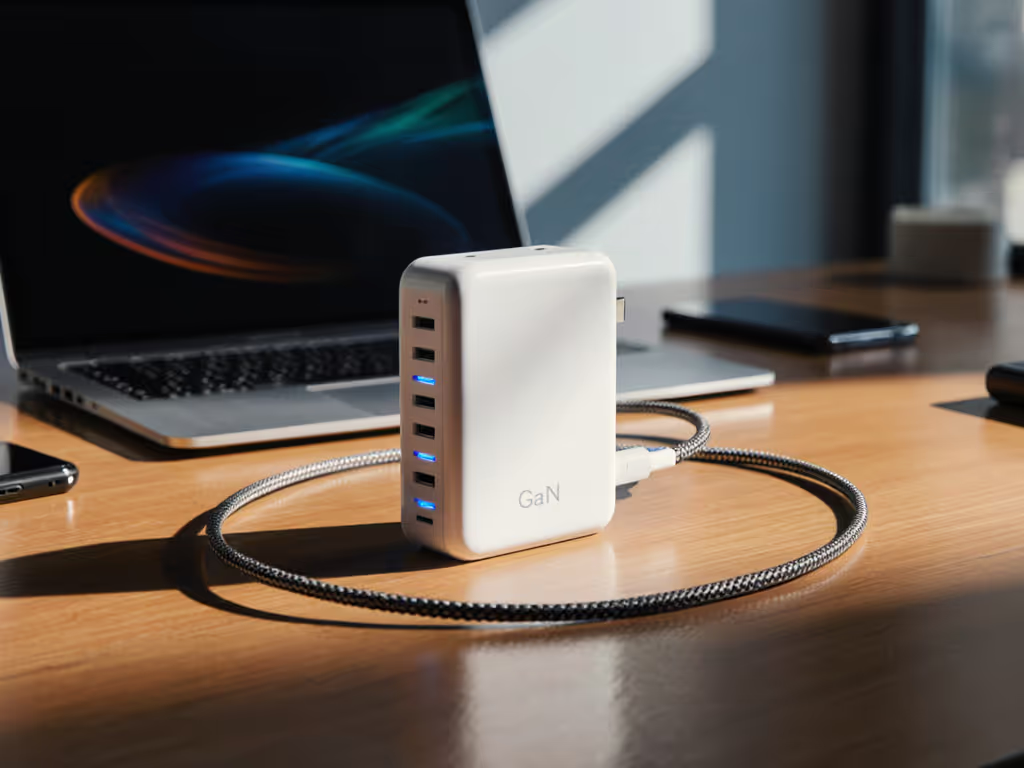
GaN power bank technology relies on Gallium Nitride semiconductors instead of traditional silicon to convert and deliver electrical power. The result is a fundamental shift in how chargers and power banks handle voltage, frequency, and heat, enabling compact designs that deliver serious wattage without the bulk or thermal penalties of older architectures. This matters because the device asking for power and the charger supplying it need to negotiate terms clearly; Gallium Nitride charging benefits emerge when both sides speak the same protocol language, and the cable connecting them carries the right specs to make it happen.
Silicon has been the standard semiconductor material for decades, but it has hard physical limits. Silicon's bandgap (the energy required to move an electron across its structure) is 1.1 electron volts (eV). Gallium Nitride semiconductors have a bandgap of 3.4 eV, which means they can handle much stronger electric fields without breaking down. This wider bandgap allows GaN transistors to shrink dramatically while handling the same (or higher) power levels.
In practical terms: a GaN charger's internal switching transistors are smaller, closer together, and vastly faster than silicon equivalents. The switching speed advantage is dramatic: up to 100 times faster than silicon depending on the design. Faster switching means the charger's internal components (transformers, capacitors, filters) can be made smaller and lighter, because they handle less energy per cycle. This is why modern USB-C fast chargers are the size of an old deck of cards instead of a brick.
Yes, but the specifics matter more than the marketing claim. GaN vs silicon technology differs in how much electrical power reaches your device versus how much bleeds away as heat. GaN chargers are approximately three times as efficient as silicon-based chargers at converting power to usable electricity. That is not marketing hyperbole, it is rooted in lower internal resistance and capacitance, which reduce energy loss.
Lower resistance means fewer volts drop across the charger's circuits. For the science behind conversion losses, see our battery efficiency guide. Lower capacitance means faster, cleaner power transitions. Combined, these properties mean more watts actually flow to your phone, laptop, or power bank instead of warming the charger itself. In a 65-watt charger, that efficiency difference translates into cooler operation, smaller heatsinks (or none at all), and faster charging delivery to your device.
But here is the honest part: gallium nitride efficiency gains are only fully realized when the entire chain is designed correctly. A high-efficiency GaN charger paired with a non-e-marked cable or connected to a device that cannot negotiate the right power delivery protocol will not achieve that 3x advantage. The cable is a component, not an accessory. Predictable negotiation beats luck.
GaN's ability to operate at higher frequencies while maintaining low losses unlocks a design revolution. Traditional silicon chargers top out around 10-20 kHz switching frequency; GaN chargers can operate at 100 kHz or higher. At higher frequencies, the energy-storing components (capacitors, inductors) can be an order of magnitude smaller because they do not need to store as much charge per cycle.
A 140-watt USB-C charger using GaN can be hand-sized. If you need portable laptop charging, compare our 100W+ laptop power banks for sustained output metrics. The same wattage in silicon would require a brick as large as an old laptop power supply. Smaller size also means lower weight (critical for travelers, remote workers, and anyone who counts grams).
But compact does not mean fragile. GaN semiconductors also tolerate higher maximum temperatures than silicon. This thermal margin is why thermal management advantages of GaN allow designers to either remove cooling components entirely (passive designs) or keep them minimal. A cooler-running charger is also a longer-lived charger; heat is the enemy of battery lifespan and component reliability.
GaN technology itself is agnostic to port count. What it enables is the ability to deliver higher power density from a single chip. A multi-port charger with GaN can distribute 100+ watts across USB-C and USB-A ports simultaneously because the core conversion circuit wastes less energy as heat, leaving more headroom for real-world power sharing.
However, the practical constraint is not GaN, it is power delivery protocol negotiation. Not sure which protocol your devices use? Start with our PD vs QC guide to avoid mismatches. Each port must negotiate independently with its connected device. If two devices plug into the same charger and both request maximum power, the charger's total wattage is fixed. GaN helps because it lets the charger reach that high total in a small form factor, but you still need clear labeling of which ports get priority and how power is shared under load. Vague marketing claims about "simultaneous fast charging" often hide this complexity.
Partially. Many power banks ship with low-wattage USB-C inputs (5-18W) despite having 30-65W USB-C outputs. This asymmetry means your power bank takes 8-12 hours to refill, even though it can empty in 2-3 hours. GaN technology supports bidirectional fast charging, your bank can accept higher input wattage from a GaN charger, refilling much faster.
A modern 25,000 mAh power bank with GaN and a 45-watt input can recharge in under 3 hours when paired with the right adapter. See our recharge speed guide for input-wattage best practices. But again: the bank must have GaN input circuitry, and your charger must support the same protocol (typically USB Power Delivery at 20V, 9V, or 15V). This is not automatic, it requires the right cable and a charger spec sheet that lists input wattage, not just output.
Yes, within limits. GaN's higher operating temperature tolerance (compared to silicon) means it continues to work efficiently in hot environments where silicon chargers would thermally throttle or shut down. A GaN charger in direct sunlight or inside a hot car will remain functional and efficient longer than a silicon equivalent.
In cold climates, the advantage is indirect: because GaN chargers produce less heat, their internal components do not rely on external warmth to reach safe operating points. For quantified results, check our cold-weather efficiency data across battery chemistries. However, the batteries inside power banks still suffer cold-induced voltage sag; GaN does not change that. But a GaN charger reaching full power output faster means you can refill a power bank more quickly before the temperature drops further during a mission.
GaN is just the semiconductor material. It does not choose USB Power Delivery versions, PPS profiles, or whether your cable has an e-marker chip. A GaN charger can output 140 watts, but if your phone negotiates for 25 watts and your cable does not communicate the charger's full capability, you get 25 watts. The negotiation follows the weakest link: device request, charger capability, cable spec.
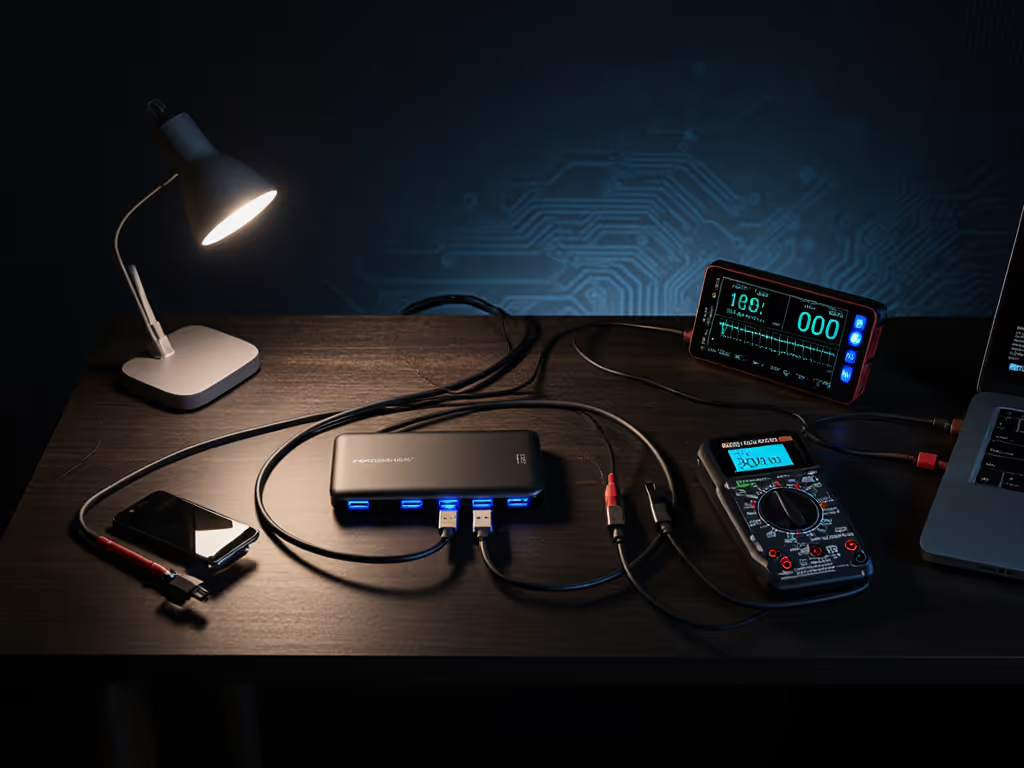
For travelers and engineers who demand predictability: buy a charger whose spec sheet lists the exact USB Power Delivery version and output profiles (e.g., "USB PD 3.1, 5A, 48V EPR, 140W total"), pair it with an e-marked cable rated for the same profile, and verify your device's input negotiation via a USB-C protocol analyzer or power meter. Predictable negotiation beats luck.
The compactness. A 25,000 mAh GaN-enabled power bank is genuinely lighter and smaller than a 15,000 mAh silicon-era equivalent, while delivering the same or faster charging speeds. This changes packing decisions for remote work, travel, and outage planning. You carry less bulk for the same runtime.
The second advantage is self-recharge speed. A GaN power bank with 45-65W input negotiation can refill during a short layover or hotel overnight, instead of requiring a full evening. For field workers, photographers, and anyone on a tight schedule, this is mission-critical.
The third advantage is thermal resilience. A GaN charger or power bank that runs cooler and tolerates higher ambient temperatures is more reliable in stress scenarios: extreme climates, always-on use, repeated fast cycles.
If you own multiple devices across ecosystems (iPad, MacBook, Android phone, gaming handheld), your next step is mapping each device's charging profile (USB PD version, PPS support, wattage target) against chargers and cables you are considering. Charger spec sheets should list max output, PD version, and whether PPS is supported. Check the cable: does it have an e-marker? What is its AWG and voltage rating?
Start by asking: what wattage does my most power-hungry device actually accept? Then work backward to choose a GaN charger that matches, paired with a verified cable. Skip the marketing claims about "ultra-fast" or "turbo charge." Look for published USB PD compliance specs, thermal test data under load, and real-world runtime measurements (not capacity alone).